

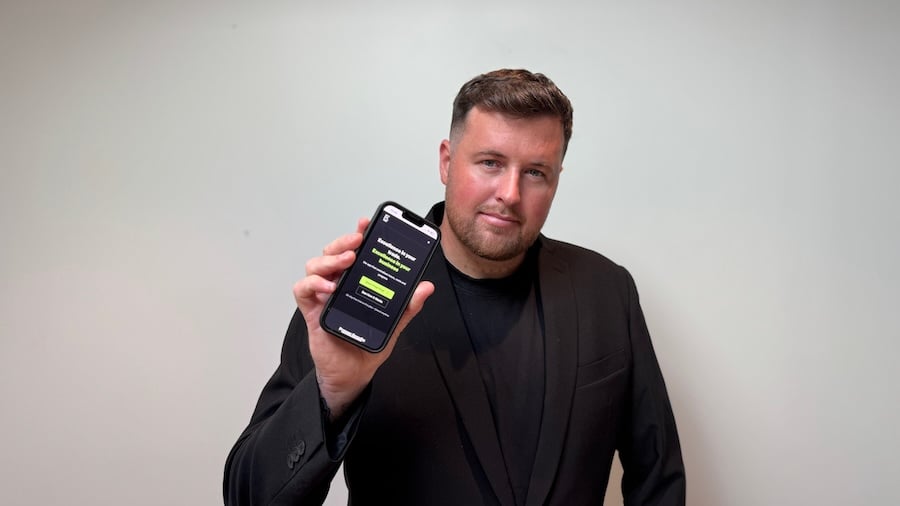
Eight years after Gene Gibson was featured on Idealog for inventing a brake-equipped ‘smart wheelbarrow’ that eventually landed in Bunnings stores nationwide, the entrepreneur is back with a different venture. And this time he’s tackling the construction industry’s admin problem.
In 2016, the 24-year-old apprentice builder was trying to bring his invention, Buster the smart wheelbarrow, to life all while working full time and supporting a young family.
His idea came after losing control of a concrete filled wheelbarrow on a building site, which was most embarrassing at the time, and prompted him to rethink a tool that had barely changed in decades.
Spotted a real problem
Gibson worked hard to secure a deal with Bunnings, marking a successful achievement for the young founder. After selling the business himself with a six figure exit, he stepped away from the product manufacturing and returned to building.
Now after nearly a decade of running his own construction company on Waiheke, he has launched Formal Tradie, a software platform designed to help builders and tradies track project budgets, and in turn, communicate more efficiently than ever with clients.
“After years of running sites, dealing with clients and wrestling with spreadsheets, I spotted a real problem,” says Gibson.
“Builders are still using outdated tools to track project expenses and communicate with clients. It’s costing them hours every week, and clients are sometimes missing out on full project budget visibility through messy spreadsheet reporting and poor internal systems.”
Built for the construction industry
Formal Tradie offers real-time budget tracking and is a client reporting platform built specifically for the construction sector. Builders can log projects, allocate budgets for labour, materials and subcontractors and log expenses as their projects progress.
Budgets update in real time and downloadable reports are instantly downloadable for clients showing financial analysis, budget variances, project health and recent transactions. Users can also connect contacts directly to projects as the software stores supplier and subcontractor information within the platform.
“We’ve also built in an AI agent ‘virtual apprentice’ that helps guide users through the tool and can perform all major tasks from creating new projects, adding expenses, logging paid items and generating client reports,” says Gibson.
Expansion plans ahead
The business idea came directly to Gibson from his own frustrations both on site and behind the scenes.
“I was spending more nights than I wanted up late manually inputting project data to spreadsheets and trying my best to keep up with client expectations,” he says. “The stress of all that was overbearing and definitely wasn’t sustainable.”
Formal Tradie officially launched in April 2026 with the company picking up over 50 subscribers within the first month. And that’s without yet spending on marketing.
“We’ve proved the model now, with early user adoption telling us it’s working,” he says. “The next phase for us is marketing.”
The company is currently seeking investment to fund expansion across New Zealand and Australia, and there are plans for radio and social campaigns for the year ahead.
Hard-won lessons
Moving from physical products to SaaS (Software as a Service) may seem like a major pivot but Gibson says both ventures were born from the same process – a personal pain point.
“With Smartbarrows, I needed a better wheelbarrow with more control,” he says. “With Formal Tradie, I needed an easy-to-use platform so I could update my clients instantly and professionally and didn’t cause me so much stress and anxiety around whether I could deliver what my client is asking for or not.”
Gibson notes that the experience of launching Smartbarrows taught him resilience and reinforced the value of backing yourself, even when things don’t initially go to plan.
“Smartbarrows taught me that self-belief and determination pay off in the end,” he says. “It also taught me that surrounding yourself with good people opens doors you didn’t even know were there.”
Practical solutions
In Idealog’s original 2016 interview, Gibson describes working through years of costly prototypes, communication challenges with manufacturers, as well as a rejected first pitch to Bunnings. All before securing a nationwide rollout.
Those lessons continue to shape how he approaches business today.
“The pattern is always the same,” he says. “I tend to notice a problem I’m living, think ‘is there a better way?’, do the market research, identify the gap and build the solution.
“One of [Formal Tradie’s] early subscribers said: ‘Just what I was looking for, finally a platform that tracks budget health and gives me the ability to update my client whenever they ask, and I can do it instantly’,” he adds.
“Tradies want breathing room, professional communication and the ability to actually run their business instead of just managing constant questions.”