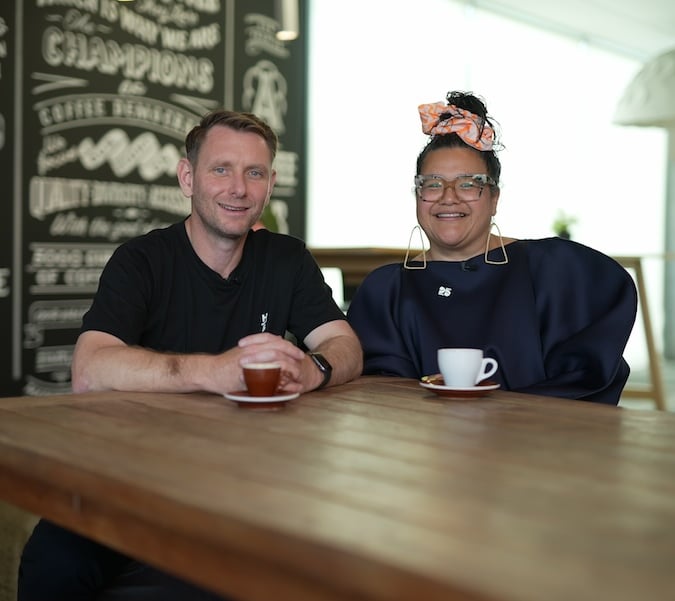


Above: Ben and Madeline Kaye are running Roots, the first ever tattoo convention to land in Tāmaki Makaurau Auckland.
Ben Kaye is a big fan of tattoo gatherings – so much so, he’s set up his own in Tāmaki Makaurau. Taking place on March 14 to 15, the Roots Auckland Tattoo Convention 2026 aims to bring together tattoo artists, tattoo lovers and anyone else curious about the art form to The Cloud on Quay Street.
Ben Kaye’s obsession with tattoos began 18 years ago when he got his first one. “I ended up having so many questions, the guy seemed to have such a cool life and I got obssessed with it,” he says.
“I like tattooing because it’s escapism for me… I enjoy the challenge, I enjoy the way it takes me into my own world for a few hours.”
It’s been nearly two decades since that “first small tattoo” changed his life. Now, after attending many tattoo conventions across the world, he’s running his own.
“I love the community that it brings to the tattoo industry. And also I enjoy talking to the general public about tattoos,” says Kaye.
Roots will host more than 200 tattoo artists, from across Aotearoa and beyond, including Australia, the UK and the Philippines. At the artists’ booths, people can observe their work, get a tattoo or buy merchandise. The event programme also includes a history exhibit, industry speakers, competitions and food trucks.
The aim is for Roots to be an annual event – the 2027 edition is already in train, says Kaye.
Industry showcase
Ahead of the convention, Roots is hosting a day just for tattoo artists on March 13. “There’s a welcoming ceremony, they can tattoo each other, we’ll have drinks and then we’ve organised a meal,” says Kaye.
Kaye, together with his business and life partner Madeline Kaye, runs Ship Shape Tattoo, a studio in Auckland’s North Shore. They also run seminars and workshops for tattoo artists.
They set up Roots because they felt there was a need for an industry event in Tāmaki Makaurau Auckland. Currently, other annual events are hosted in New Plymouth and Wellington.
“And then as soon as we started talking about the idea, people were like ‘oh really? That would be cool’,” says Madeline Kaye.
Fun for the whole family
She can’t wait to see the event come to life over the weekend: “Seeing everyone that we have collated and brought together all under one roof, seeing that buzz and excitement brought to life.”
Madeline Kaye says they want the event to be approachable and have a broad appeal. “Because a lot of the time [tattoos are] very metal and hardcore but there’s so much more to it than that.”
There’ll be arcade machines, an art installation that everyone can draw on, vendor stalls, and an art space for kids.
She adds that making the experience family-friendly opens tattoos up to be seen as an art form rather than only something you can do when you turn 18.
“Because to become a tattooist you need to learn how to draw. You tap into all these kind of art forms and that starts from an early age… You want to try and go to these conventions, see how it works, how the industry works.”
Origin stories
For Ben Kaye and fellow Auckland tattoo artists, Brock Fidow and Hirini ‘Heeds’ Katene, their tattooing journeys began at high school. They enjoyed drawing but after leaving school, they didn’t consider seriously pursuing it.
Katene found himself fascinated with moko, which was having a resurgence in Aotearoa in the 1990s and early 2000s. He started drawing his own designs, and in 2005, his dad and cousins asked him for a tattoo.
“I ended up making a tattoo machine, tattooed my family and then tattooed myself,” he says. Internationally renowned tattoo artist Gordon Toi then took him under his wing and Katene never looked back.
“I get to do what I love every day, but my favourite part is also helping out people. Our designs and the work that I do is very powerful in the sense that it helps heal a lot of people from past things or they want a new start. So they want something to remind them that, ‘Okay, I’m in a good place, I’m in good hands.'”

During Fidow’s first semester at university, he started hanging out at a tattoo studio where his friend was working – not long later, he got his first tattoo. When a spot opened up at the studio, Fidow dropped out of his degree to pursue it. “Obviously a difficult call to make to the parents,” he laughs.
Steering the client
He describes being a tattoo artist as having to be a bit of a mind-reader: “You have to know what language to use, what questions to ask to get closer to their vision while also knowing how to steer them in the right direction.”
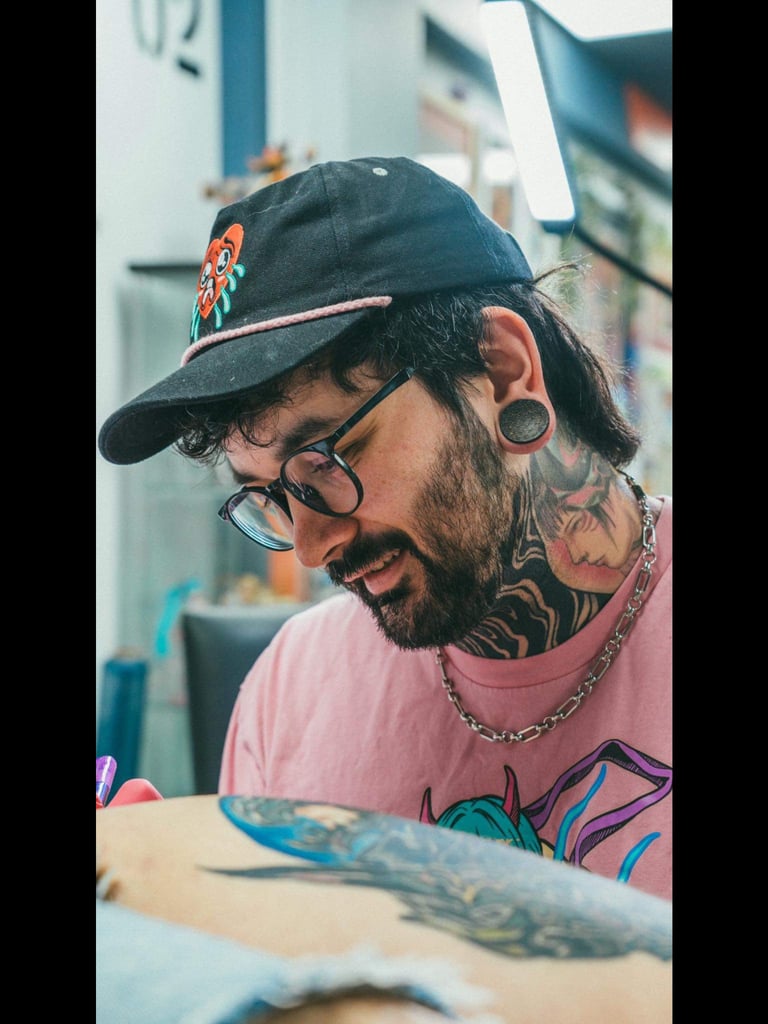
Fidow has designed his booth at the weekend to match his syle of Japanese, anime and gaming-inspired tattoos. Notably, this includes an arcade cabinet programmed with his designs. “So you can go through all the designs like a character select screen,” he adds.


Free hand flow
As well as having a booth, Katene is also one of the convention’s speakers.
He shares some insight into his creative process: every tattoo he does is one of a kind and is done directly onto the skin – no stencil or pre-drawn designs on paper.
“Clients come in, they talk aout the area they want to get done and then we have a talk about what they want it to represent, what they want it to mean. Then from there, I’ll design something to represent that.
“The reason why we draw on the skin is for flow. Not everybody has the same shaped skin. This way, each individual knows what they’re getting in terms of the meaning of the pieces being just for them.”
Katene adds that moko designs and styles are passed down through families over generations. The suppression of Māori culture throughout the 1900s meant moko as an art form was almost lost, so instead of tattooing the body, designs were preserved in wood carvings.
Arty and accesible
In his time in the industry, Kaye says the vibe has changed: tattooing has become more arty and accessible. “I think a lot of that comes down to social media and the internet… When I started, there were one or two DVD seminars and a few books, and they weren’t super easy to get hold of… The educational side boomed.”
Social media has also increased the visibility of artists’ work. Kaye has travelled overseas to tattoo clients he connected with on social platforms.
He admits it’s also a double-edged sword: social media has also created a disconnect. People see the most recent art, but not the work it took to get there. It has also elevated some artists to celebrity status which in turn can create long waitlists.
But the increased visibility of tattooing has created a sustainable career path for artists the world over, says Fidow.
“Now, it’s like every second person in New Zealand has a tattoo,” he laughs. “It’s still difficult but it’s a more steady, stable job that some other creative careers. And the more tattooing I’ve done, the more creative freedom I’ve got because those clients have become friends and trusted me to do more of what I love.”